
Reflections on the urban development of Sub-Saharan Africa: why is it of fundamental importance now?
Africa and Asia are the epicentres of global urbanisation today.¹ Africa is expected to experience one of the largest expansions of building floor area in the world in the period to 2050, reaching more than double its current size.² And we are totally unprepared.
Before 2030, about seventy million new houses (roughly equivalent to one-quarter of Africa's total residential building stock in 2018) will be needed in African cities, mostly to respond to the housing needs of the growing middle-income population.³ Scholars have recognised that sub-Saharan institutions, in particular, are not sufficiently prepared to manage current and future population numbers.
Against this background, after 2008, the private sector played a major role in initiatives in the African urban context: arguably, following the housing crisis that affected developed countries, real estate investment firms sought new markets in places with favourable conditions.⁴ Osman observed that urban space production is political and that there is a need to redirect available funds to support a collective structure rather than individual needs, towards solutions for everyone; with this objective in mind, the private sector cannot play a central role, and governments should step in.⁵
At the moment, however, despite the crucial importance of understanding these land development processes, there is a paucity of studies investigating the extent of the influence of private-sector decisions on collective urban growth.
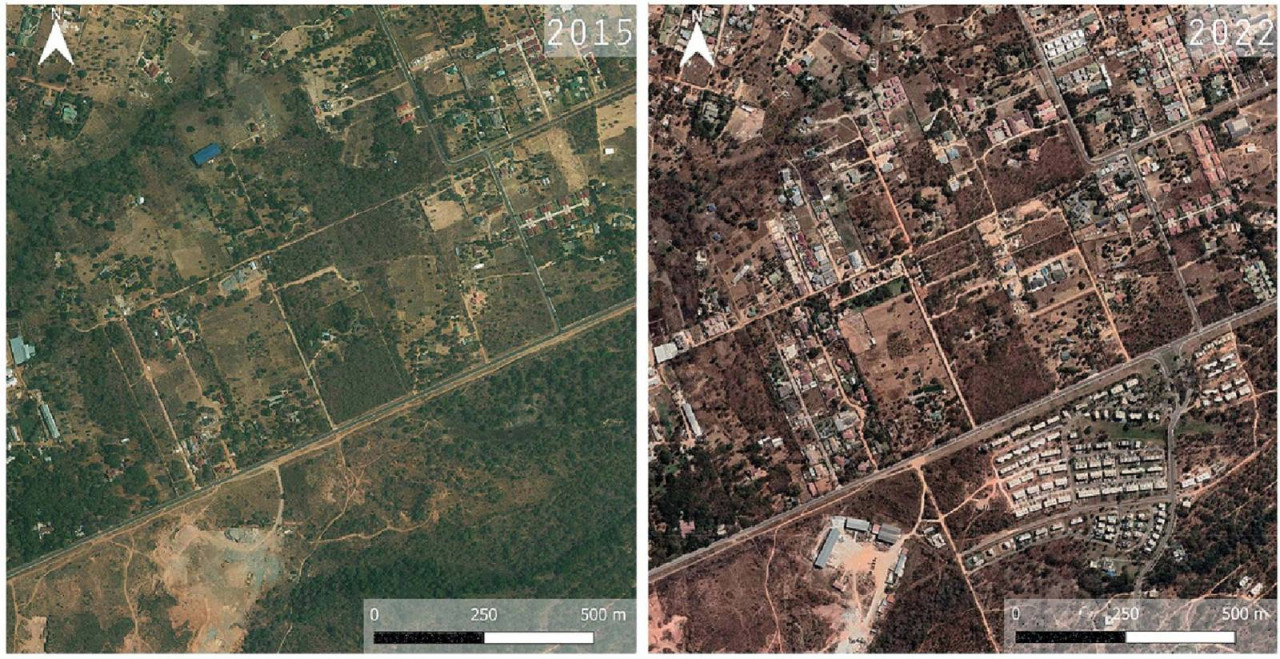
In sub-Saharan Africa, investments are also frequently supported by international funds, with processes driven by the priorities of donors and non-state actors playing a crucial role in the heterogeneity of urban patterns.⁷ Figure 1 shows the risky outcome of these land transactions: highly fragmented urban development is evident in the peri-urban areas of Lusaka, Zambia. In this remote sensing imagery, diverse urban morphologies punctuate previously agricultural lots and national forest reserves. However, human development rights should not interfere with the environment's right to exist. Peri-urban forests are too often under pressure because they are perceived as available land by the urban population and property developers.⁸
Garba meaningfully observed that the idea that the environment can be capitalised is not, however, a consequence of the problem; rather, it is the root of the problem: how can Africa stay outside of capitalisation? Sustainability is not a technical concept; rather, it is a political question.⁹
Liveable urban environments require alignment and integration among different investments and policies, expanding individual policies into a development strategy capable of sensitive placemaking. African cities have their own backgrounds and complexities, which exist alongside those of the West.¹⁰ Transdisciplinary scholarly approaches are therefore urgently needed: the context and history of a place matter.
The entry point for sustainable development in sub-Saharan Africa is an inclusive and resilient plan towards urban systems that allow individual expression while moderating the collective structure. Places 'driven by values of equity, access and dignity',¹¹ not enriching a wealthy minority at the expense of the poor.¹²
Author
Federica Fiacco is an architect and researcher advocating for just and low-carbon urban transitions in developing cities. Her research explores the relation between urban imaginaries and low-carbon city densification models.
She received a PhD from the Department of Architecture and Civil Engineering of City University of Hong Kong, and holds a Master's degree in Architecture (with honours) from Sapienza University of Rome. Currently, she volunteers as "Project Management Junior Lead" at the Initiative for Climate Resilience Planning (ICRP) at ISOCARP, and she's one of the Young Academics Regional Ambassadors at AESOP.
Footnotes
- Vera Songwe, 'Africa's urban transformation', Developing Urban Futures, Urban Age Conference, Addis Ababa, Ethiopia, 29–30 November 2018, https://lsecities.net/wp-content/uploads/2019/07/Final-Developing-Urban-Futures-Urban-Age-conference-newspaper.pdf.
- International Energy Agency (IEA), Africa Energy Outlook 2022 (2022), https://iea.blob.core.windows.net/assets/6fa5a6c0-ca73-4a7f-a243-fb5e83ecfb94/AfricaEnergyOutlook2022.pdf.
- International Resource Panel (IRP), United Nations Environment Programme, The Weight of Cities: Resource Requirements of Future Urbanization (2018), DTI/2172/PA, https://www.resourcepanel.org/reports/weight-cities.
- Vanessa Watson, 'African urban fantasies: dreams or nightmares?', Environment and Urbanization, 26, no. 1 (2013), pp. 215–231, https://doi.org/10.1177/0956247813513705.
- Amira Osman (ed.), 'Cities, space and power', in The Built Environment in Emerging Economies (BEinEE): Cities, Space and Transformation, vol. 1 (Cape Town: AOSIS, 2020), pp. i–183.
- F. Fiacco, K. Jere and G. Talamini, 'Energy implications of the Chinese-driven morphological transformation of Lusaka, Zambia', Science Talks, 8 (2023), 100261, https://doi.org/10.1016/j.sctalk.2023.100261.
- L. Oates, 'Sustainability transitions in the Global South: a multi-level perspective on urban service delivery', Regional Studies, Regional Science, 8, no. 1 (2021), pp. 426–433, https://doi.org/10.1080/21681376.2021.1995478.
- U.S. Agency for International Development (USAID), Land Tenure Dynamics in Peri-urban Zambia: Policy Brief, Tenure and Global Climate Change (TGCC) Program (2018), https://urban-links.org/wp-content/uploads/Tenure-and-Peri-urban-Zambia-Brief_FINAL.pdf.
- F. Garba, 'Capital (in)difference in Africa', in Routledge eBooks (2020), pp. 45–63, https://doi.org/10.4324/9781003090137-4.
- M. Novelli, 'Historicising the geopolitics of education and the SDGs: From Western hegemony to a multi-polar world?', International Journal of Educational Development, 103 (2023), 102925, https://doi.org/10.1016/j.ijedudev.2023.102925.
- Amira Osman, 'Crisis is an opportunity to heal South Africa's divisive spatial geographies', The Mail and Guardian, 17 July 2021, https://mg.co.za/thought-leader/opinion/2021-07-17-crisis-is-an-opportunity-to-heal-south-africas-divisive-spatial-geographies/ (accessed 1 March 2024).
- Oxfam International, '10 brilliant questions you asked about Oxfam's inequality report' (2021), https://www.oxfam.org/en/blogs/10-brilliant-questions-you-asked-about-oxfams-inequality-report (accessed 20 February 2024).
When you subscribe to the blog, we will send you an e-mail when there are new updates on the site so you wouldn't miss them.


Comments