
Built but Disconnected: Can a City Become Empty While Growing?
Cities don't forget.
People are the ones who leave.
Yet Tirana was never abandoned.
It remained full of people,
but somehow,
it emptied itself.
Houses gave way to towers.
Courtyards became parking lots.
Narrow streets disappeared beneath asphalt,
and memory was buried
under glass and concrete.
Here, people never left.
They simply kept remaking the city
until it could no longer recognize its own face.
Because sometimes,
a city is not lost when it is abandoned.
It is lost when it is rebuilt
as though it had never existed.
|B.Basha|
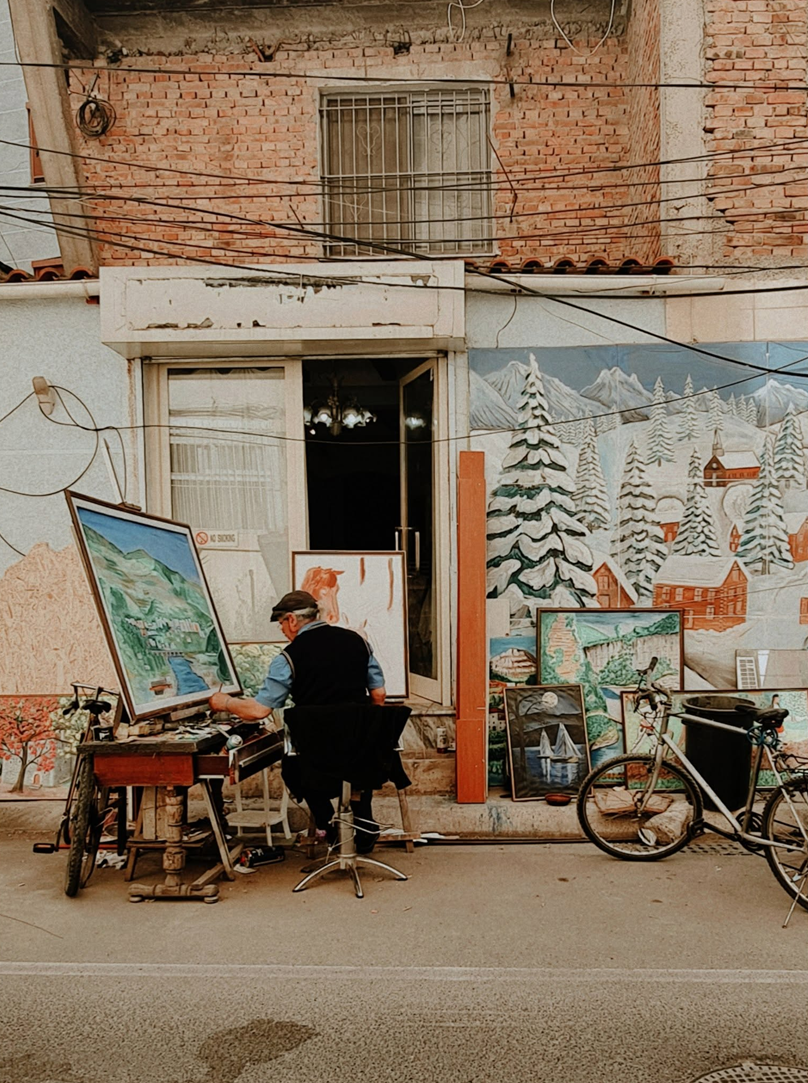
An old photograph of Tirana can be strangely difficult to place. The location may be familiar, yet the buildings, proportions and spaces between them belong to another city. A house has disappeared. A courtyard has become a building plot. A tower now dominates a view once held together by lower rooftops. We can identify where the photograph was taken while struggling to connect it to what stands there today.
This tension is the starting point of my research on architectural erasure in contemporary Tirana. As an architect and lecturer, I am interested in what happens to our relationship with a city when its familiar surroundings change. My question is simple: can a city become empty while remaining physically full?
At first, Tirana seems an unlikely place to ask this. Its streets are active, construction continues, and new buildings announce the city's ambitions. The emptiness I am concerned with, however, is an experience of disconnection that may emerge within this activity. It occurs when the places through which people recognize their lives gradually disappear, even as the city gains more built space.
Consider an ordinary house with a courtyard. Its architectural value may seem modest. For those who know it, however, it might mark a childhood route, a neighbors' home or a place where families gathered. Demolition removes the physical setting that made these experiences easy to locate. Memories can survive through stories and photographs, but their relationship to the everyday city changes. The remembered place becomes something that must be explained: "There used to be a house here."
Tirana's overlapping historical layers make this relationship particularly important. Ottoman traces, interwar Italian-influenced planning, socialist buildings and post-1991 development coexist within its urban landscape. These layers carry different, sometimes conflicting meanings. They also allow the city's history to remain visible. When redevelopment repeatedly replaces them, the question becomes how much continuity can be lost before familiar surroundings become difficult to read.
The relationship between memory and place has a long theoretical history. Maurice Halbwachs understood remembering as a social process, while Aldo Rossi connected collective memory to the architecture of the city. Kevin Lynch showed how recognizable routes, landmarks and districts help people form an image of their surroundings. These ideas help explain why a building can matter beyond its appearance or function. It may be part of the shared framework through which people orient themselves and understand where they belong.
In my research, I use architectural erasure to describe the cumulative weakening of this framework. A single development may be assessed through its design, programme or economic contribution. Across a neighborhood, however, many separate interventions can alter the relationships between buildings, streets and everyday activities. The effect becomes visible at a scale larger than any individual project.
The National Theatre illustrates a particularly direct rupture. Its demolition in May 2020 removed a longstanding cultural landmark. The campaign to preserve it revealed how strongly a building could become associated with civic life and contested ideas about the city's future. This does not mean that everyone valued the theatre in the same way. It shows that decisions about redevelopment involve meanings that cannot be captured by comparing the technical performance of old and new buildings alone.
The replacement of historic villas raises a quieter version of the same issue. Their loss may attract less attention, yet repeated changes can transform the grain of entire streets. Small entrances, gardens and intermediate spaces can disappear as individual plots accommodate larger developments. A city's recognizability depends partly on these ordinary relationships, which are easily overlooked when heritage is understood mainly through exceptional monuments.
The Pyramid offers a different possibility. Its transformation by MVRDV, completed in 2023, retained the concrete structure while introducing educational and cultural activities and steps that make its sloping exterior accessible. A recognizable building has acquired new uses without requiring its physical disappearance. Whether this strengthens attachment needs further investigation, but it demonstrates that substantial change can work through an existing landmark.
I describe the tension between increasing built space and weakening continuity as the Urban Fullness–Emptiness Paradox. Perceptual Urban Emptiness names its possible experiential consequence: living in the same city while feeling less connected to it. These concepts are propositions to investigate. Photographic comparison and architectural observation can reveal physical change; understanding what that change means to residents requires listening to them.
Experiences will differ. A tower that interrupts one person's remembered skyline may become another person's first home. A socialist landmark can evoke attachment, discomfort or both. New buildings can generate meaningful relationships, just as older environments can exclude people. The challenge is to understand whose connections redevelopment supports, whose it disrupts, and whether people have a meaningful role in those decisions.
For planning, this means examining cumulative change alongside individual projects. Mapping buildings scheduled for replacement is useful, but so is identifying the routes, meeting places and everyday settings that resident's value. Conversations, neighborhood walks and comparisons of old and new photographs could make these relationships more visible. Adaptive reuse can preserve some connections; retaining access, affordable uses and opportunities to gather may be equally important. A preserved façade alone cannot sustain neighborhood life.
Tirana will continue to change. The question is how to make that change leave room for both new experiences and recognizable traces of what came before. We should be able to welcome new architecture while asking what its arrival removes from the shared life of the city. The future of cities depends not only on what is built, but also on what is remembered.
About the author
Brunilda Basha is an architect, poet, researcher and lecturer at the University of New York Tirana. Her work explores architectural history, Ottoman heritage, urban transformation and the relationship between the built environment, collective memory and place atmosphere.
When you subscribe to the blog, we will send you an e-mail when there are new updates on the site so you wouldn't miss them.


Comments