
Artificial Intelligence (AI) in Planning Theory and Practice
By Tiernan FitzLarkin
Introduction
The launch of ChatGPT by OpenAI in 2022 arguably marked the beginning of a new era that has extended far beyond the technology sector. The platform amassed over 100 million users within months of its launch, propelling AI into professional and personal settings everywhere. While AI itself is not a recent phenomenon, its widespread accessibility and usability by the public is. Therefore, for a discipline such as planning that is continually evolving in response to changing circumstances, the emergence of AI into the mainstream of society requires serious consideration. In particular, the discipline should consider what AI might mean for the fundamental processes within planning. As the profession grapples with increasingly complex challenges globally, AI presents both opportunities and challenges, not all of which have been exhaustively considered below.
Opportunities with AI
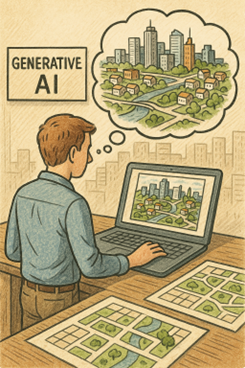
The potential benefits of the technology are substantial and warrant consideration, particularly in the context of emerging challenges in the built environment, such as increasing urbanisation and climate change. Firstly, AI has the potential to enhance the analytical capacity of the built environment. Cities generate an unprecedented amount of data from various sources, including sensors, mobile devices, satellite imagery and social media. AI could help analyse these datasets to reveal insights regarding existing challenges that may have gone unnoticed and where potential interventions might be required. This evidence base could support more informed decision-making within respective urban areas. Secondly, the emergence of AI has the potential to greatly enhance the efficiency of planning systems. Planning tasks are often time-consuming and administrative. This includes the responsibility of validating planning applications, as well as analysing and responding to consultation responses. These processes could be largely automated using AI, leaving planners time to focus on substantive work that requires human input. Thirdly, AI could enhance communication and participation within the planning process. The planning system can often feel inaccessible to much of the public, particularly within some demographics, such as those from poorer socio-economic backgrounds who have limited exposure to the processes and lack familiarity with the relevant policies or legislation. AI has the potential to reduce these barriers by translating complex technical documents into more accessible language and providing real-time responses to queries. Furthermore, the technology has the potential to create a more engaging participatory process. Through the real-time generation of images and models, AI could facilitate immediate feedback and support iterative design changes that reflect public input.
Challenges with AI
It is critical however that any optimism for the technology is matched with scrutiny of its purported promises, alongside an acknowledgement of the challenges that may emerge from its use by the planning profession. There are several fundamental concerns that require the attention of planners. Firstly, AI is not an objective referee. It reflects the assumptions and biases of the data used to train the model. These biases can vary from geographic, given that most AI models are trained on data from East Asia and North America, and demographic, given that those from socio-economically deprived backgrounds or ethnic minority groups are less likely to be represented in the algorithms. Limited context-specific understanding within diverse regions may hinder the reliability of the AI to generate outputs that are neutral. Framing AI as an objective tool arguably contradicts established theories that consider planning as inherently political and involving competing interests. AI does not overcome this tension, it may obscure it. Secondly, AI systems require vast quantities of data to produce accurate outputs. This raises critical questions regarding data governance, specifically, who holds authority over this information and where it is stored. If planning systems begin to rely on personal data to train AI models, it is imperative to consider whether adequate safeguards are in place to ensure data security and prevent misuse by third parties for unethical or exploitative purposes. Thirdly, the adoption of AI, as with any emerging technology, requires investment and training. These technologies are relatively new to planning professionals and will likely require substantial expenditure to implement effectively. However, this may exacerbate geographical disparities between wealthier and poorer regions, further deepening existing inequalities. Moreover, it is essential to consider whether the use of AI will genuinely democratise the planning process, or whether it will primarily benefit those with the digital access and literacy required to engage with such tools.
A Path Forward
The emergence of AI across all facets of society is not a temporary trend, it is here to stay and forms part of the reality of the global environment. Planners must therefore critically evaluate its application within the discipline to ensure that the principles and values that underpin the profession are maintained. The challenges associated with AI are multifaceted and require a range of approaches to ensure its successful integration into planning practice, several of which are discussed below.
• Regulatory Frameworks: The establishment of a standardised framework to govern the development and deployment of AI would enable the emergence of more robust models that account for diverse demographics, geographies, and planning systems. The European Union has already begun this process through the EU AI Act, reflecting a growing concern over the lack of defined rules. This absence has significant implications for ethical use and data privacy. Regulatory frameworks could enable the establishment of ethical standards and ensure better legal accountability.
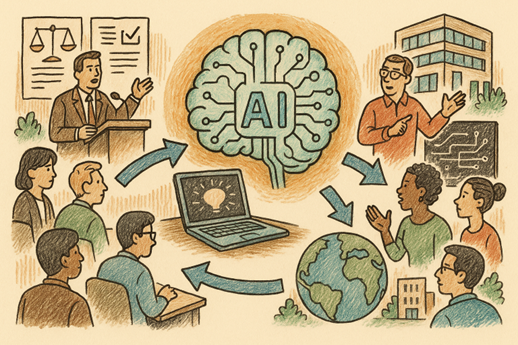
• Professional Education: The education of planners has evolved considerably over the past century, reflecting changing societal priorities and the emergence of new theories and technologies. AI is arguably the most recent development in this trajectory. Planning education should equip future practitioners and support the development of current professionals to engage critically with the technology. This includes understanding its capabilities and limitations, analysing its outputs and maintaining human judgment to ensure robust and informed decision making. This does not mean that every planner must become a specialist, but it is essential that professionals remain informed and responsive to the growing use of these technologies.
• Participatory Tool Development: A key issue discussed is the potential unreliability of existing models in capturing context-specific data across diverse demographics and geographic regions. To mitigate this, it is essential that AI models can generate outputs tailored to specific localities and planning environments. One method to achieve this is by involving a broad range of stakeholders in the design and testing of localised AI tools to be used within the planning process. This participatory approach could support the development of bespoke tools that are tested across different stakeholder groups, ensuring they reflect the requirements of the respective planning system. This approach may also help mitigate algorithmic biases and safeguard privacy concerns.
As AI continues to reshape the global landscape, it is essential that planning remains proactive in its approach to the technology.
Tiernan FitzLarkin is a PhD Researcher based at Ulster University in Belfast, Northern Ireland. His research area is in reimagining planning processes using artificial intelligence.
When you subscribe to the blog, we will send you an e-mail when there are new updates on the site so you wouldn't miss them.


Comments