
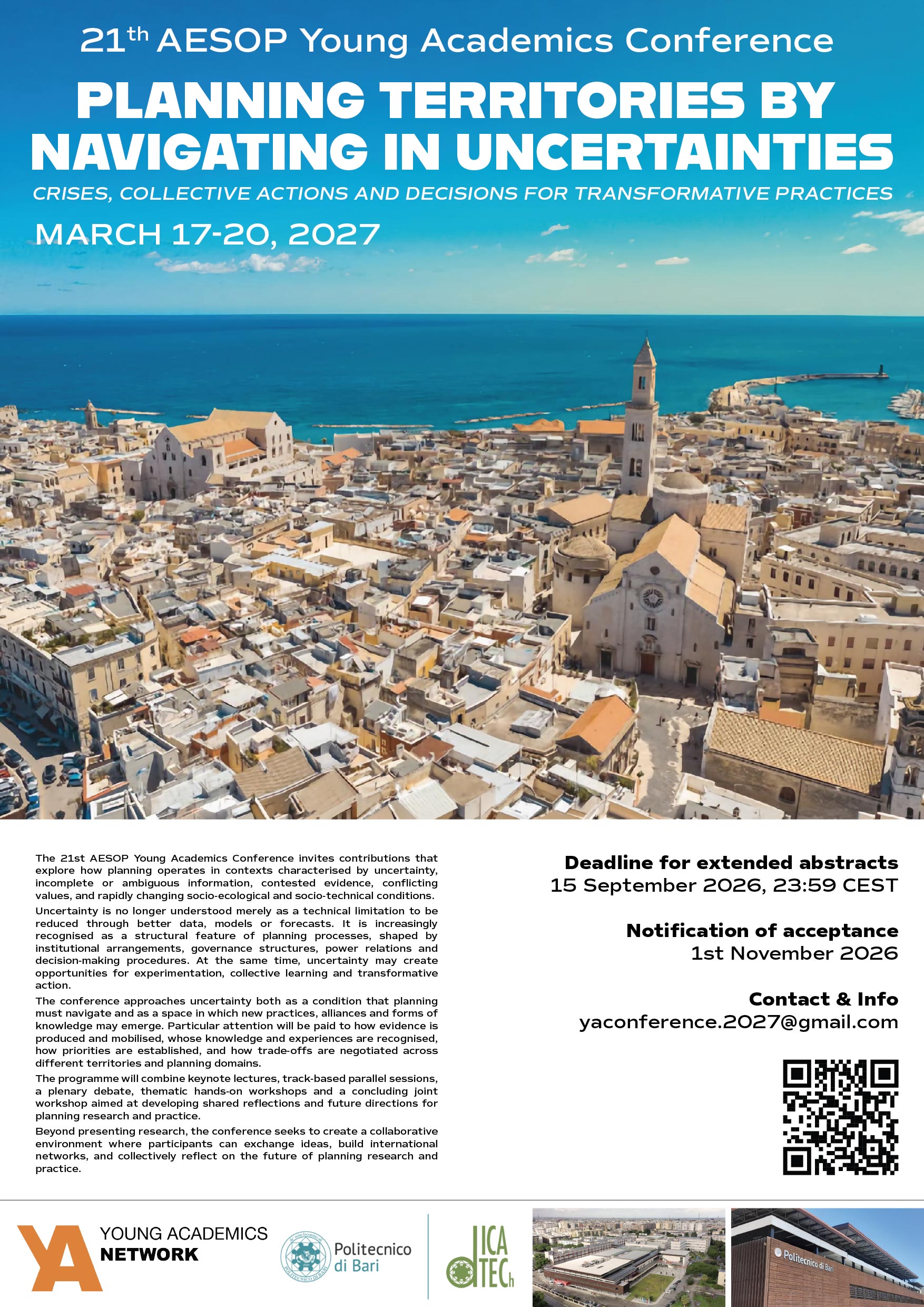
ABOUT THE CONFERENCE
The 21st AESOP Young Academics Conference invites contributions that explore how planning operates in contexts characterised by uncertainty, incomplete or ambiguous information, contested evidence, conflicting values, and rapidly changing socio-ecological and socio technical conditions. Uncertainty is no longer understood merely as a technical limitation to be reduced through better data, models or forecasts. It is increasingly recognised as a structural feature of planning processes, shaped by institutional arrangements, governance structures, power relations and decision-making procedures. At the same time, uncertainty may create opportunities for experimentation, collective learning and transformative action.
The conference approaches uncertainty both as a condition that planning must navigate and as a space in which new practices, alliances and forms of knowledge may emerge. Particular attention will be paid to how evidence is produced and mobilised, whose knowledge and experiences are recognised, how priorities are established, and how trade-offs are negotiated across different territories and planning domains.
The programme will combine keynote lectures, track-based parallel sessions, a plenary debate, thematic hands-on workshops and a concluding joint workshop aimed at developing shared reflections and future directions for planning research and practice. Beyond presenting research, the conference seeks to create a collaborative environment where participants can exchange ideas, build international networks, and collectively reflect on the future of planning research and practice.
THEMATIC TRACKS
1. Risks and Adaptations: Planning Scenarios
This track explores how planning responds to risks, crises and long-term pressures in conditions of uncertainty. Particular attention is given to scenarios, the framing of possible futures and the governance of uneven risks across territories and communities.
2. Transitions or Transformations: Facing and Activating Change
This track focuses on processes of change in planning, including transitions in energy, mobility, services and territorial development. It invites reflections on how pathways are shaped, contested and implemented, and on when incremental change may lead to deeper transformation.
3. Everyday Uncertainty: Creating and Negotiating Places of Change
This track examines how uncertainty is experienced in everyday life through insecure living conditions, unequal access to housing and services, affordability pressures and social vulnerability. It considers how planning decisions distribute costs, opportunities and capacities to act.
4. Uncertainty in Model-Mediated and Data-Intensive Planning Environments
This track explores how models, data, digital technologies and artificial intelligence shape planning processes, influence evidence production, and affect legitimacy and decision-making under uncertainty.
Full descriptions of the tracks, including guiding questions and information on the related thematic workshops, are available on the conference website.
HOW TO REGISTER AND SUBMIT
REGISTRATION: Create an Indico profile
Register on the AESOP Congress platform:
https://congress.aesop-planning.eu/event/5/overview
If you have already attended the AESOP 2025 Istanbul Congress, please use the same profile.
ABSTRACT SUBMISSION: Submit your extended abstract
Deadline: 15 September 2026, 23:59 CEST
GUIDELINES FOR EXTENDED ABSTRACTS
Extended abstracts should comply with the following requirements:
• Length: 1,000–2,000 words
• Language: English
• References: APA7 style (References should be entered only in the dedicated reference field and should not be included in the main abstract text)
• Track selection: applicants must select one main thematic track
• Keywords: three to five keywords
Suggested structure:
• Introduction and research problem
• Conceptual or theoretical framework
• Methods
• Results or expected results
• Discussion and conclusion
• References
Please do not use numbered headings or numbered lists in the extended abstract. Graphics should be numbered, for example “picture_1.jpg”, and referred to in the text as [picture_1]. Tables should be submitted separately as .xls or .xlsx files and referred to in the text, for example [table_1]. Multiple authors are allowed. However, submissions co-authored by a young researcher and their senior
mentor or doctoral supervisor are not eligible.
WHO SHOULD APPLY
We welcome contributions from:
PhD students and candidates; Postdoctoral researchers within 5 years of PhD completion; Early-career academics and researchers working in spatial planning and related fields
Relevant disciplinary areas may include urban and regional planning, urbanism, geography, architecture, governance and policy studies, environmental studies, sustainability, spatial justice, territorial development, data science and related interdisciplinary fields.
We particularly encourage interdisciplinary contributions and comparative perspectives addressing planning challenges across different geographical and institutional contexts. Participants from all countries and institutional backgrounds are encouraged to apply. Contributions from outside Europe and from researchers affiliated with non-AESOP member institutions are particularly welcome. The conference aims to foster an open, interdisciplinary and inclusive environment in which young researchers can exchange ideas, receive constructive feedback and develop international academic networks.
CONFERENCE FORMAT
The conference will take place at the Polytechnic University of Bari from Wednesday, 17 March, to Friday, 19 March 2027.
The programme will include:
• opening and synthesis keynote lectures;
• track-based parallel paper sessions;
• a plenary debate;
• four thematic hands-on workshops;
• a concluding joint workshop;
• two best paper awards;
• social and networking activities.
An informal welcome gathering will be organised on the evening of Tuesday, 16 March.
A half-day excursion or study visit will take place on Saturday, 20 March. Further details will be announced at a later stage.
FINANCIAL SUPPORT
• No conference participation fee will be charged.
• Lunches and coffee breaks will be provided during the conference.
• A limited number of travel bursaries (up to €400) may be available. Details on how to apply will be
provided after abstract acceptance.
BEST PAPER AWARDS
Two paper awards will be presented during the conference:
• disP – The PlanningReview: Best Conference Paper Award;
• Plurimondi – An International Forum for Research and Debate on Human Settlements: Best Thematic Paper.
Authors wishing to be considered for either award will be invited to submit a full paper before the conference. Specific eligibility criteria, submission guidelines and deadlines will be communicated following abstract acceptance.
KEY DATES
Event Date
Deadline for extended abstracts 15 September 2026, 23:59 CEST
Notification of acceptance 1st November 2026
Full-paper deadline for Best Paper Award candidates [date to be confirmed]
Informal welcome gathering 16 March 2027
Conference 17–19 March 2027
Half-day excursion 20 March 2027
VENUE
Polytechnic University of Bari
Department of Civil, Environmental, Land, Building Engineering and Chemistry – DICATECh
Bari, Italy
All academic activities will take place in a single venue at the Polytechnic University of Bari, within walking distance or easy public-transport access from Bari’s central railway station and city centre.
CONTACT & INFO
Conference website: https://aesop-youngacademics.net/ya-conference-2027
If you have any problems, feel free to e-mail:
